


June '22
the mountains, a rhythmic heartbeat: Tan's first encounter with damnation...
Bangladesh is truly a land of wonders, with its vast plains, rolling hills, mangrove forests, and endless rivers. It even hides a beautiful atoll island, waiting for those who seek it. The moment my university semester break arrived, I embarked on a journey to unravel the secrets and philosophies of my Motherland.
Encountering mountains for the very first time was a breathtaking experience. Pedaling through the diverse landscapes of the motherland, covering a 1032 km route on my bicycle, left me utterly impressed. But something even more profound happened during this journey – I fell head over heels in love with the mountains, finding myself addicted to their allure. If you were to ask me how I'd like to spend a perfect day, I'd paint a picture of myself climbing a solitary hill on a bright afternoon, basking in the tranquility and just breathing in the crisp air. The thought of taking a break under the shade of a tree after quenching my thirst with a sip of water felt equally enticing. And then, the urge to climb another mountain, to explore valley after valley, began to take hold.
However, my first attempt to see a mountain didn't go quite as planned. One December night, under the shroud of darkness, my parents left the house without a word, carrying my bike, a small backpack, essentials, and a heart full of curiosity. With no clear destination, I pedaled aimlessly all night and into the next day. This impromptu adventure had a purpose, though. Burdened by the academic pressures of the semester, the stress of final exams had overwhelmed me. To find solace, I cycled an astounding 260 kilometers in a day, channeling my pent-up restlessness into the rhythmic motion of the pedals. Leaving Dhaka behind, I journeyed to various places, including Mawa Ghat via Munshiganj-Louhajong, then to the picturesque Shariatpur after crossing the ferry, and onward to Ajpara in Gopalganj, passing through Madaripur, Gournadi, and Agailjhara. Finding refuge in my grandfather's village, I relished the embrace of my grandmother's love and the simple joys of nature – running through fields, climbing trees, and savoring life's little pleasures. During this respite, a calm and sweet plan began to take shape within me.
With my mother's assistance from Dhaka, I arranged for essential supplies to be couriered to me. Little did I know, these items would go missing along the unknown paths I would tread on my bicycle. And thus, a new chapter of my journey unfolded.
After enduring my grandmother's cuisine for ten days, I set out for Bhola on a crisp Christmas morning. That day, I crossed paths with two remarkable individuals – Ishrat Jahan, a history student from Ratnapur, and Abdur Rahman Chacha, a cargo truck driver hailing from Laharhat in Sherpur's Jhenaigati. Ishrat's thoughts and perspectives mirrored my own, making for an instant connection. While cycling along a deserted village path in Ratnapur, fate intervened, and Ishrat, along with her two friends, unexpectedly crossed my path. My bicycle's unconventional warning, a backward pedal and a rattling chain, brought us together in an amusing way. This chance meeting led to Ishrat's friendly advice to get a bicycle horn, and she generously shared insights and beautiful visions with a warmth that seemed to embrace the world.
On the Laharhat ferry, with the soothing December breeze against my skin, as I floated along the Baghai River, I encountered another source of inspiration. Abdur Rahman Chacha stirred my spirit with stories of the Persian poet Sheikh Sadi. He shared tales from Sadi's literature, exploring the essence of travel and the key facets of human existence, imparting wisdom about life's pursuits, its significance, and our roles within it. His words resonated deeply, urging me to embrace diversity and connect with people from all walks of life. "If you can't blend with people of different backgrounds, races, religions, professions, and experiences, like melting wax..." While I may not recall his exact words, the sentiment remains etched in my memory. Abdur Rahman's genuine and heartfelt guidance, accompanied by the melodies of Uttarbong, left an indelible mark on my soul.
My time spent at Bhola Zilla Parishad Dak Bungalow, under the care of Sundarman, was truly enriching. And so, with renewed vigor, I set my sights on my next adventure – the mountains. Crossing the Meghna River at dawn, I ventured into the land of Lakshipur and reached Mozu Chowdhury's Ghat. Enveloped by the breathtaking December weather, I journeyed to Feni via Chaumuhani and Mahipal. This day marked the end of smooth pathways, as the bitter winter of December 27th pushed me onward from Baroyarhat. People's reactions shifted to apprehension upon learning of my destination – Khagrachari. Amidst the intrigue and uncertainty, I remained steadfast in my determination to explore the mountains that had ignited my passion.
Stay tuned for more tales of adventure and self-discovery as I continue my quest to unravel the mysteries of my beloved Motherland.
Venturing east of Chittagong was an entirely novel experience for me. It had never been part of my sweetest dreams. My journey took me thirty kilometers from Ramgarh, leading me to my very first real climb. Innocently, I started pedaling with all my might, blissfully unaware of the necessary gear combinations for my mountain bike. After a faltering start and a break to drink some water midway up the climb, I tried again. My heart raced within my chest, pounding like a stallion. Thirsty and slightly drowsy in the winter chill, I persisted, finally reaching the summit to experience a moment of pure significance – my inaugural hilltop sit-down. It was a tranquil and iconic instant that would forever resonate with me.
That evening, I stayed in Matiranga upazila, finding respite in an exceptional boarding house. The accommodation was a far cry from luxury, with tin-roofed houses and only tube well water for use, all at the cost of a hundred taka. Fatigued from my journey, the basic provisions were more than enough. That day, my sustenance consisted of an assortment of treats – fuska, chatopti, rasgolla, channa, badam, jhalmuri, cholabut, steamed pitha, and khichuri. The mountains had an uncanny ability to magnify hunger and desire.
The following day, I felt an intoxicating rush. The road to Panchari Upazila, passing through Tanakkapara, initially seemed uncertain due to security concerns. Yet, to my surprise, it turned out to be perfect as I journeyed halfway. My first significant uphill challenge was Jharnatila, which, although I now jestingly refer to as "big," seemed monumental at the time, lacking any frame of reference. Logang, the northernmost union of Khagrachari, caught my attention on the map. Intrigued, I decided to explore its allure, tracing the road that led to the Chenggi River. Notably, I was oblivious to the history of Logang, including the tragic events of April 10, 1992, and the lingering unease between the tribal inhabitants and Bengalis. As fate would have it, I found myself amidst the tribal settlement, navigating conversations and situations that evoked a sense of trepidation. While the experience was somewhat unnerving, it shed light on the complexity of the region's dynamics.
Returning to Panchari Upazila, I realized the profound impact of my journey to Cheng. The day felt bitterly cold, the sensation etched into my memory. December 29 marked a turning point – a day etched forever in my heart.
Setting out from Panchari, I reached Khagrachari town with no concrete plans. My tendency to part with money easily had taken its toll. Over breakfast, I discovered that my funds were running low. Visiting the development shop, I learned that its operations were suspended for two days. Left with 107 taka in my pocket, I embarked on a journey to Dighinala. A tribal market provided sustenance in the form of bananas, wild bread, and toasted biscuits. Starved, I reached Dighinala without the opportunity to eat – a luxury I reserved for moments of dire hunger. Now possessing only 64 rupees, I moved forward to Baghaihat, where an army checkpoint lay. From here, a solitary road led east – the path to Sajek. Known for its risks, not everyone was allowed access. Pedaling with my gaze fixed downward, I felt an instinctual need to avoid eye contact. I was flagged down – a stern voice commanded, "Stop right here."
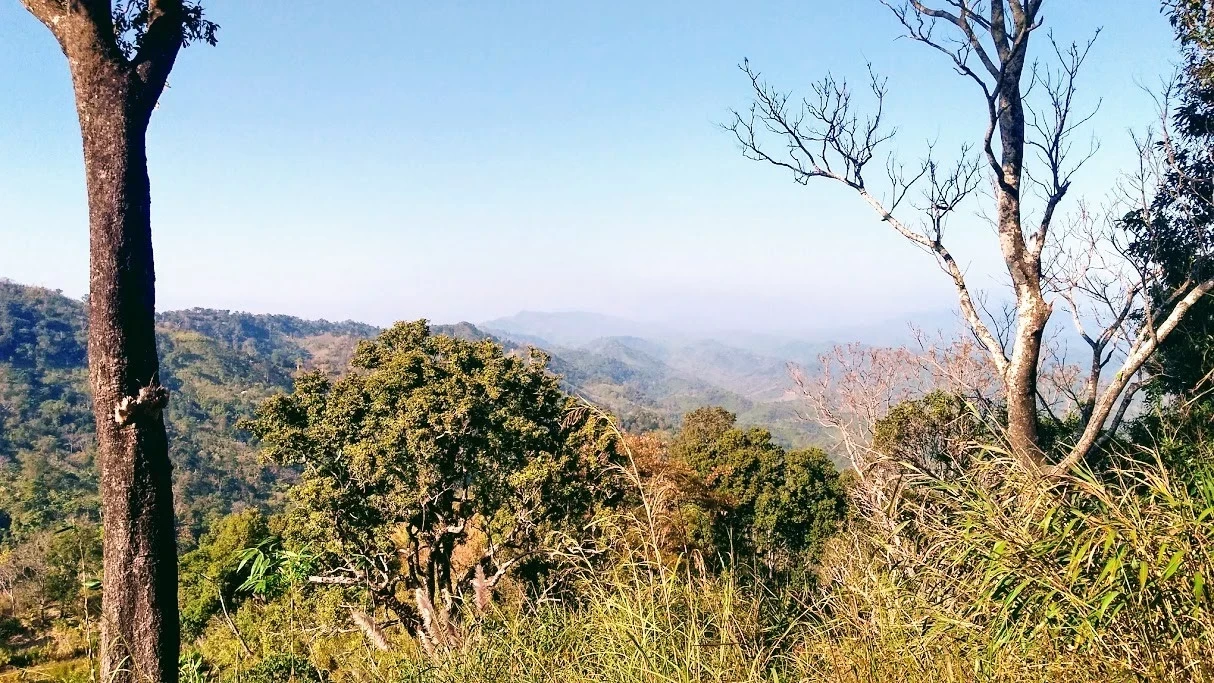
Perhaps I wore an expression of vulnerability, for rarely was I met with harsh treatment. Yet, within three minutes, the army personnel smiled kindly, tapped me on the back, and granted me passage to Sajek Road. The sensation was akin to that of a free-spirited bird. A fleeting look of gratitude exchanged, I focused ahead. The road meandered, unveiling mist-clad mountains and an otherworldly blue sky. The scenery evoked happiness and a sense of liberation, dispelling hunger, weakness, and anxiety.
The time was 2:50 p.m.
The route from Baghaihat to Sajek spanned 34 kilometers of hilly terrain, beneath a sky that defied earthly description. The village of Nandaram exuded bravery and cheerfulness. The Uzu market was a picture-perfect sight, and the primary school of Hamachang Furongni boasted pristine beauty. As I cycled through the Shankhachli valley, the local hill children greeted me with encouragement, their enthusiasm contagious. One memorable uphill segment involved racing with a group of eight- to ten-year-olds, and their triumphant chants of "tata, tata" echoed through the air as we descended. I wore a continuous grin as I coasted downhill.
Having conquered the imposing hills, I finally laid eyes on a true mountain just two days ago. Despite my slow learning curve, I quickly mastered the art of bicycling. Not far from Nandaram, a skyward climb awaited me. Straight as an arrow, it caught me off guard. Patiently, I tackled it step by step, inching my way upward. An elderly man, looking rather bored, sat near the corner. Before ascending the hill, I stood beside him, gathering my courage. With a hint of breathlessness, he inquired, and I responded with a shy smile. The old man introduced the valley as Shankhachali. With nightfall on the horizon, there remained a ten-kilometer journey. The initial five kilometers were downhill, akin to a ditch, while the final five kilometers presented an uphill ascent that seemed to reach for the heavens. Unbeknownst to me at 5:40 pm on December 29, this was the path I would tread.
As I gazed up, the enchanting village of Ruilui, illuminated with a spectrum of lights, lay ahead. Awaiting me were washed rice, a cozy room, a neatly-made bed. Meanwhile, here I was, perched on the valley slopes, lying down under the stars, with a chorus of insects feasting on leftover bananas. By the time I finally obtained all these comforts at 7 pm, I felt as though I had aged a decade in the past ninety minutes. Not merely a proverb, my mind had genuinely expanded after that day. I felt akin to Brother Moun-Mahan, ablaze with the mountain's fire. A powerful sentiment captured in Sunirmal Bose's poetic words.
Amidst the evening's starlight and braving the biting cold December wind, I contemplated my accommodations for the night. The thought of reaching the ethereal solitude of Ruiluipara inspired me. In the distance, a melodious tune emanated from behind one of the hills. Moving closer, I discovered a Tripura woman sitting in front of a charming cottage, singing and laughing with her young son. During election periods, motor vehicles were prohibited, thus deterring tourists. My unexpected presence seemed to startle her momentarily, but upon seeing me, weary and leaning against my bicycle, she ceased her song. Inviting me into her cottage, she arranged for my stay and, despite her limited Bengali, provided instructions on where and how to find food. Observing the neatly arranged bed, I felt a longing to retire, although, in typical boyish fashion, I changed clothes and took a shower before succumbing to slumber. The water was shockingly cold, a sensation intensified by the mountain air. I ventured outside to bathe and procure some rice. Sympathetic to my plight, the cottage owner refrained from requesting an advance payment. I decided to settle the bill on my departure day. The sole open restaurant served me dinner that night. I learned that rice, dal, and bharta could be had for 70 rupees, exclusive of other costs. The news left me both content and slightly dismayed – could one not dine for a mere 6 rupees at night? A memory suddenly surfaced, reminding me that I had stashed a few coins in my bag from Gopalganj. My fortune was intact – I now possessed a total of 86 rupees. After savoring a dalbhat meal that evening, 16 rupees remained untouched.
Morning greeted me as I emerged from beneath my covers. I dressed in black trousers, layered a jeans overshirt over a faded blue flannel shirt, slipped on suitable walking boots, tucked sunglasses into my pocket, secured a handkerchief, placed a water bottle in a small backpack, and donned my favorite cap. Ready for a walk on my first mountain adventure, excitement suppressed any feeling of suffocation. Swiftly locking the door, I stepped outside with 16 rupees to my name. The budgetary calculations commenced – I reasoned that with four bananas and a loaf of bread, I could spend the entire day. When hunger struck, a banana and a slice of bread could tide me over, totaling four meals. More than sufficient. However, my search for bananas yielded no results. With my belt cinched tight, I ventured eastward. Along my path, I passed Sajek Army Camp on foot. A genial man from the camp beckoned me over. We engaged in conversation for about two hours, fixating our gaze on the mountains of Mizoram, India. Amidst discussions of bananas, he presented me with a large bunch from his stash. I questioned the feasibility of walking while holding a banana, to which he suggested I stay and consume as many as I could before packing the rest into my backpack. It was a brilliant solution that left us both laughing heartily.
With farewells exchanged, I set out toward the north. During my walk, I encountered a place that resembled a high hill. Etched on the ascent was the name "Kanglak Para." At the far end of Kanglakpara, a large tree beckoned in the distance. I sat beneath its branches, savoring two bananas. Lost in thought, I wondered about a route that would allow me to return to the vicinity of Ruilui by evening. A Marma teenager caught my attention – he sat cutting something to size. Following the path he indicated, I continued walking, seemingly lost in the sound of the Bhardupur sun. My journey continued, my laughter accompanied by my progress. It was astonishing how far I had ventured without realizing. A mere week ago, mountains were a foreign concept. Yet now, the soothing murmur of the mountain breeze stirred my heart, and the most exquisite beauty unfolded before my eyes.
I walked to satiate my hunger for bananas and retraced my steps. I couldn't gauge the distance I had covered. Upon my return to Ruiluipara, the western sky glowed vivid red. Rushing to the open expanse, I settled on the ground, staring at the wide-open sky. How long I remained there, I couldn't fathom. As twilight painted the sky in unearthly hues, I found myself back in front of my cottage in the heart of Ruiluipara. The cottage owner greeted me with a warm smile. After spending some time together, I set off in search of dinner. This time, there were no restrictions – I could indulge as I pleased, thanks to the lifting of the development limits. I sought out my favorite restaurant in Khuzape, a round tented establishment. A young Marma woman called out from the back room, expressing surprise at my presence. Curious about my arrival, as no vehicles were running, she was amazed to hear about my bicycle. I later learned that she summoned her younger brother, instructing him to prepare eggs while she arranged everything else. Sincerely apologetic, she explained that only eggs, vegetables, potato filling, and pulses were available. The restaurant was technically closed, and the offerings were essentially their dinner. I felt like an unexpected guest, but they both graciously made me feel welcome.
Dinner took a while as I recounted my day of hiking across mountains, fueled only by bananas and water. A generous serving of rice, a bowl of vegetables, and a large pot of dal were set before me. The two siblings looked on, undoubtedly surprised by my appetite. As I was finishing my meal, I noticed their hushed conversation in an unfamiliar language. While slightly embarrassed, I refrained from intruding on their private exchange. Strangely, they quoted a price when I initially inquired about the meal, but upon finishing, they refused to accept payment. Their resolute refusal left me feeling somewhat bemused. Darun, with a sincere smile, suggested that I settle the bill when I returned, a promise I surely wouldn't forget.
Every moment seemed to bring new surprises. Departing the restaurant with a heart warmed by their generosity, I walked along the Akabaka hillside and came across a campfire. The entire Ruiluipara neighborhood had gathered in the front yard of the local church, with a powerful sound system playing a soul-stirring melody in an unfamiliar tongue. Young village girls danced to the rhythm, crafting a dreamlike tableau. As I walked away and turned a corner, another surprise awaited me – a Siberian Samoyed dog appeared out of nowhere. The dog's exuberance was infectious; he clung to me, desperate for attention, seemingly yearning to rest his head on my shoulder. Pondering his origins, I traversed the entirety of Ruiluipara with my newfound canine companion. Eventually, I stumbled upon his owner, a jovial Tripura Kishori who delighted in seeing her beloved dog so thoroughly entertained.
Returning to my cottage to settle my accommodations, the owner greeted me with a shy smile. He revealed that his cottage had been closed for the past three days, and he had simply invited me into his home – no payment needed. I couldn't help but be moved by the sincerity of the people of Sajek. I insisted multiple times that I had sufficient funds and pleaded with him to reveal the rent of his cottage. Yet, he remained steadfast in his refusal, slightly embarrassed by my persistence.
The following morning, I set off on my bike before anyone else awoke. As I headed west, the dog from the previous night suddenly appeared out of thin air. Not forgetting to capture the moment with a photo, I bid him farewell and once again embarked on the heavenly road of Sajek, my mind lost in dreams. The experience felt surreal, a journey beyond the realms of fairy tales. Eventually, I retraced my steps along the heavenly path of Sajek to conclude the year. From there, I ventured to a remote and enigmatic town called Marishya. The subsequent year saw me traveling from Marishya to Rangamati by launch, a seven-hour journey that proved to be an incredible adventure. As I crossed Kaptai Lake and sailed down the Maini River, I was entranced by the captivating scenery of Mainipar and the mist-shrouded mountains that marked the horizon.
Bersik Maini cast a shadow over the beauty of Kaptai, perhaps explaining my smooth journey from Rangamati to Bandarban. The road from Assam Basti to Kaptai Upazila has to be one of the most serene and scenic routes in all of Bangladesh. This road led me through the enchanting Bangalhalia before I finally reached Bandarban. The beauty of vast Rangamati had already left an indelible mark on me. It seemed as if everything around me was ablaze with shades of green and blue! However, upon reaching Bandarban, Paduto began to show signs of wear. My bike's pedal came off, and I somehow managed to pedal back home with just one foot on the frame. Later, as I journeyed along the roads of Thanchi upazila, passing through Ruma Y Junction, Chimbuk, and Nilgiri one by one, a sense of beauty enveloped me, dispelling the discomfort I had experienced during the earlier phases of my journey.
On that particular day, from morning till noon, I had been ascending hills constantly. At times, it felt as though I would ascend straight into the sky, with no descent in sight. Just when I started to believe this notion, I encountered the most exhilarating downhill stretch I had ever seen – a continuous 7 km descent. Ekabeke flowed gracefully down the mountainside into the valley, an exhilarating experience that required constant braking to keep the speed in check. At times, releasing the brake for a mere second could send the speedometer soaring to 60! Some words might have escaped my lips, and what was to the side of the road? Emptiness.
I can't recall how much later it was, but as I gazed down from the valley below, my fingers had turned almost numb, my knees were trembling, and the gust of wind that had been blowing past my ears like a tempest suddenly ceased. The world around me seemed incredibly quiet, almost eerily still, and if one were to look into my eyes, they would have glimpsed a glimmer of otherworldly bliss! It was the moment a mountain biker lives for – I knew it right then! I knew it! That was it! The name of the valley was Bolipara. I observed how towns nestled within hilly valleys were reminiscent of Bengalhalia. Yet, my homeland remained capricious. The afternoon in Bolipara was yet another one of those afternoons that slowly transition into evening, leaving the heart heavy with melancholy.
It was without a doubt the most demanding day of my youthful life. The muscles in my left leg were nearly immobilized, but I managed to make it from Bandarban to Thanchi. Upon arriving in Thanchi, I caught my breath in front of the BGB camp. A group of soldiers gathered around, with one of them proudly pointing out the Egg Hill – Bangladesh's highest motorable road!
I found restful sleep in Thanchi. Before retiring, I had indulged in a filling meal of rice. In the morning, I embarked on a quest for khichuri and eggs. When I awoke the next day, my left leg felt almost paralyzed. Yet, I was certain that once I got into the saddle, it would respond favorably. Ajanm's steadfast companion didn't disappoint. With a deep breath, I bade farewell to Thanchi and pedaled onward toward Alikadam. I hadn't conducted any research or study about Dim Hill. Up until the previous day, I didn't even know where it was located. Each time I encountered an uphill stretch, I wondered, "Is this the start? How high is Egg Mountain Road?" Eventually, I stumbled upon an oval-shaped hill about twelve kilometers southwest of Thanchi. Around eight kilometers before that, however, I encountered the most challenging climb of my entire journey. It was a demanding ascent – before I realized, I had already climbed Egg Hill and began descending again. It suddenly dawned on me – I had left the highest road behind. The ascent was arduous, to say the least. It was exceptionally tough. There's no climb harder than this in all of Bangladesh, yet the scenery was breathtakingly exquisite. The sky was a profound blue, a hue so deep that my patience never wavered. Throughout, I gazed at the sky, drawing inspiration from its expanse. The descent from such heights was treacherous. The slope was incredibly steep; even the most daring person would feel their heartbeat quicken. I experienced the same sensation. With utmost caution and complete self-control, I descended Dim Hill and reached Alikadam.
My affinity for Alikadam had deep roots. The name evoked memories of a detective novel – "I am Robin," a title that many would recognize. The protagonists visit a village named Ashok Taru in Alikadam; to this day, I'm unsure whether this village is real or fictional. Robin Milford and Rakib Hasan spoke of a stunning mountain river. I had read those lines and imagined the scene; that afternoon, I saw the exact depiction – the Matamuhuri River! There were moments when I felt the urge to call someone and ask, "Where is Ashok Taruta? My shoe is torn; I need to get it repaired!" My affinity for Aliqadam was profound.
The era of conquering hills was nearing its end. Farewells exchanged, the heart brimming with sorrow – it's a sensation only those who've said goodbye to the mountains can truly comprehend. I couldn't quite grasp why I felt that way. The reason behind my sentiments would become clear much later.
Originally, I had intended to go to Chittagong and catch a train back to Dhaka, ensuring I'd be back in university class the following morning. However, witnessing the bustling activity in Chakaria stirred something within me, and a longing for cover resounded in my already softened heart. Without much thought, I boarded a bus. Shyamoli Paribahan took me straight to my doorstep, ending my journey exactly where it began.

