


June '22
Bikepacking Through The Coast Of Bangladesh: Longest Sea Beach & Largest Mangrove On Earth Awaits!
After a grueling journey that took me from the Shyamnagar range of the Sundarbans, along the coastline of Bangladesh, and through river after river, I finally arrived at the fabled town of Bengal – the border with Burma, nestled on the banks of the Naf River, where the Bay of Bengal shone with its radiant blue hues. In the span of 21 days, I had encountered 32 rivers, engaged in peculiar conversations, experienced moments of frustration, found myself captivated by the surroundings, and reveled in the exquisite freedom that these days brought. These were days that would forever be etched in my memory.
Within the heart of the Sundarbans, someone mistook me for a Coast Guard, while the residents of remote areas believed I was a journalist. On Kutubdia Island, I became synonymous with the army. Countless times, I transformed into a peddler, and I met many strangers who extended their genuine friendship. The allure of the green landscapes frequently beckoned me, guiding my explorations. I recalled a young boy from the inn in Afazia Bazar, Monir, who was in Class Tenparua; he had promised to visit Dhaka and stay at my home. In a nameless town in Nijhum of Satkhira, I had received an invitation to Asashuni that I hadn't had the chance to follow up on. And should I ever venture to Teknaf, could I possibly not meet Aziz Bhai?
Throughout this journey, my experiences intertwined with the lives of countless individuals, forming an intricate tapestry of encounters and memories that I would carry with me forever.

It all began one afternoon in February. As I crossed Burigoalini's Kheyaghat with a mix of excitement and impatience, I dismounted my bicycle on the muddy path of Gabura Union. However, I couldn't help but feel the weight of suspicious eyes fixed upon me. Undeterred, I entered a weathered shop with mud walls, offering a friendly smile. To my surprise, when I inquired about cold beverages from the fridge, the two women in the shop stared at me as if I were speaking an unfamiliar language. "Why the surprise for asking for juice?" I thought, puzzled by their reactions. But it wasn't about the juice; it was about me. In an almost aggressive tone, they questioned my reason for being in Gabura. I couldn't help but chuckle at the situation. I responded with a hint of a southern accent, praising the beauty of their village and claiming to be a photojournalist on a quest to capture the image of the elusive Royal Bengal Tiger to secure my job. Their initial wariness softened. It seems they had mistaken me for a journalist, coastguard, or even a policeman – anything but a naive bicycle traveler.
On the seventh day since leaving home, I embarked on a journey that took me from the meandering roads of Dhaka, Gopalganj, Narail, Jessore, and Satkhira to the tranquil towns along the edges of the expansive Sundarbans. Starting from Shyamnagar in Satkhira, my destination was Koira Upazila in Khulna district, passing through Kaikhali, Harinagar, Burigoalini, and Gabura along the Sundarbans embankment. As I sat by an unfamiliar canal and nibbled on bread, I felt a certain lethargy creeping in due to the saline air from the south. However, my destination was still distant, and I pushed on.
My gaze narrowed as I fixed my eyes on the horizon, where the merging line of beauty and sky held an almost mystical allure. As I basked in the scene, the wind tousled my hair and a shiver ran through me – a sky resonating within my chest. Even with closed eyes, I continued to feel its presence, reluctant to break the spell. As I rose from my reverie, the western sky transitioned into a serene blue. Now, the question was where to pitch my tent. Despite the assurance that tigers didn't venture into these parts, urban tales lingered, and a sense of unease remained. An obliging local uncle offered guidance, sharing that heading south along the embankment would lead me to Chandnimukha. The name itself was enchanting – a place where the moon meets the river.
Upon arriving in Chandnimukha, the next challenge was finding the chairman's house. A helpful uncle gave me a lift and walked alongside me for half a kilometer. There, he introduced me to another uncle, and together they accompanied me to the Union Parishad (UP) office in the market area. Unfortunately, the chairman wasn't at home. Determined, my companions connected with him by phone, and we began making our way towards the market. The journey led us over a hill, the distant market noise gradually grew clearer in my ears. Suddenly, amidst the clamor, a familiar voice reached me – "Bro on the bike, Bro on the bike!" I turned to find a friendly man running barefoot, holding his shirt pocket with one hand, and flashing a broad smile. "I called you so many times, and you only listen now! Are you traveling? Alone?" His infectious grin lit up the scene. "I'm sorry, brother," I explained, "I thought you were calling someone else," I gestured towards a fellow cyclist nearby. "Aha, why would I bother to call him, I see him 500 times a day!" He exclaimed, bursting into laughter.

After the initial reception and the curious circle of people, the motorbiker's horn honking marked the beginning of a unique interaction. Tears welled up in my eyes – such an unexpected and warm welcome! As I shared my plan to cycle along the Bangladesh coast to the Burmese border, I was offered a cup of red tea at the village tea shop, and the village elders requested, "Tell us a bit of your story, it's quite intriguing!"
The Kholpetua river flowed through the mangroves near the tea shop, and as simple villagers traversed the unfamiliar path of Akabaka, the sense of solitude seemed to intensify, amplifying the atmosphere. Gazing southward, the place's name echoed – Chandnimukha! It was there that I encountered Green at the market. He introduced himself as the younger brother of the chairman's uncle, having recently completed his Higher Secondary Certificate (HSC) exams. He stood out among his siblings for being the only one to pursue education, his village upbringing lending him a more mature appearance. It turned out that the chairman's uncle was away in Satkhira for the city corporation election.
At the village's solitary mosque, I joined Sabuj for the Maghrib prayer. Later, I visited the chairman's uncle's home, where Auntie welcomed me warmly. We visited the two-story building that had been partially damaged by a whirlwind. Auntie and I chatted, she showered me with questions, and her hospitality was beyond praise. She even took me to a pond, where I was introduced to her friends. Their focus on me made it impossible for me to take a bath, and I struggled to contain my laughter amidst the slightly awkward situation. Eventually, I decided to forego the bath and returned to the green market.
The market was small, fitting within the palm of my hand, a picturesque scene indeed. This remote town had electricity for only two months, marking a recent milestone. Green proved to be an engaging companion. He spent the entire afternoon and evening with me, sharing stories and listening attentively, forging a sense of camaraderie. As the moonlit night descended, we sat and talked at the high school field. It felt as if Green was an old friend, the conversation flowing easily.
Upon returning to the house around 8 pm, I indulged in reading a novel in the room allotted to me. In the meantime, the house owner graciously served me a meal of rice, Rajhas meat, red vegetables, and pulses.
After a restful sleep, I woke up the next morning, not having bid farewell to Auntie or Green the previous night. The morning passed, and Green was nowhere to be found. My Airtel SIM card had no network coverage in Gabura, and I was left without a way to reconnect with Green.
It was a day that stirred a mixture of emotions, laden with significant events. Amidst these events, one incident stands out prominently, unfolding in a place known as 'Kaligar' by the locals. However, in this narrative, I'll refer to it as Prashanthipur – a magical realm cloaked in shadows, an enchanting locale that holds personal significance for me. Prashanthipur rests within the precincts of Dakop upazila in Khulna district.
On that particular day, personal concerns had cast a shadow over my morning, which persisted into the afternoon and evening. My cycling journey led me through various terrains – from the cobbled dirt paths to rutted pavements, at times with brickwork, along the quiet and deserted roads to the south of Koira. The day's sustenance was modest – two biscuits, four batasas (sugar drops), and copious amounts of tubewell water.
The journey took me to Gilabari Ghat and then the Rajsik Shanta Ferry Ghat. I was astounded by the expanse of the river at Shanta's launch, which transported me to Prashanthipur – a place that felt magical in its own right. The paths were smooth amidst the open wilderness, surrounded by isolated localities reminiscent of romance novels. In this isolated village, a fair was unfolding, attracting people from all around to indulge in batasa, jilipi, manda mithai (sweets), and other delights. Children were purchasing toy bombs, gunpowder pistols, and enjoying rides on peacock carts. Women donned veils as they explored the fair in groups, traditional village-Bengali songs resonating from the speakers. The late afternoon sun cast its glow upon the scene, which I absorbed intently through my black sunglasses. Numerous emotions cascaded through my vacant mind, prompting me to seek conversation. Alas, my phone lacked network coverage. Faced with this solitude, I began conversing with myself, the words flowing like a stream. Though I can't recall everything I said, one resolution took hold – to return to this place someday with a cherished individual who could share in my thoughts and speak freely, knowing every facet of me. Shanta to Prashanthipur – a route I would traverse with this special person, someone with whom conversation would flow boundlessly.
Without embarking on any further adventures, without tugging at any other strings, I would ensure this promise. To the west, 28 kilometers away, lay Mangla, where I planned to rest, eat, and reach out to my loved ones. The sight of Mongla port's lights as I passed Baniashanta junction in the evening brought forth a hearty laugh. Upon reaching Mongla city, I hauled my bag to the hotel room on the third floor. Following a soothing bath, I headed to Sureshwar Hotel, where I indulged in two plates of Biryani.

The Bangladesh part of the Sundarbans boasts four distinct ranges – Burigoalini, Khulna, Chandpai, and Sarankhola. These names carry an air of thrill, akin to the ethereal winds that sweep through these regions. The silence is so profound that the occasional calls of unnamed birds, the distant mooing of a cow, or the rhythmic sound of a domestic tube well being operated become strikingly vivid. In this environment, there's little to gaze upon aside from an expanse of greenery and sometimes the presence of saltwater, a sight that's utterly captivating.
From childhood, the Sarankhola range held a special fascination for me, for reasons I cannot pinpoint. The path that branches off to the right from Jeodara Bazar continues its journey into the heart of the Sundarbans, extending to its ultimate border at the confluence of the Bhola River and Bagi Canal, all the way to the Mohanachhoya Sarankhola Forest Office. The road leading to Sarankhola Forest Office is a wonderful offroad trail. As the mangrove ridge fades into the distance on one side, a path lined with enchanting flora and fauna awaits, resembling a massive python winding its way through nature's tapestry, painted in a rich shade of green on either side.
Resting at the Sharankhola Dak Bungalow brought rejuvenation, readying me for the journey ahead. Heading south from Sarankhola through Patharghata, I encountered the challenge of crossing four rivers – Baleshwar, Bishkhali, Payra, and Andharmanik. The road from Mathbaria to Patharghata carried the fragrance of hay, and the golden leaves falling from the trees on both sides formed a natural tunnel, subtly hinting at the arrival of spring. This sight, the leaves falling as if in a dance, etched itself into my memory.
While crossing the Bishkhali river, I inadvertently left my cap behind, allowing the playful winds to toy with my hair. Observing the incomparable beauty of the two pools formed by the Bishkhali river, a future plan took shape – the idea of constructing a sailing boat and embarking on a three-month journey along the rivers of Bengal. In this endeavor, I envisioned the presence of a companion named 'Ami,' who would share this experience as a partner, for there are countless thoughts and conversations that can only be shared while floating serenely on the waters.
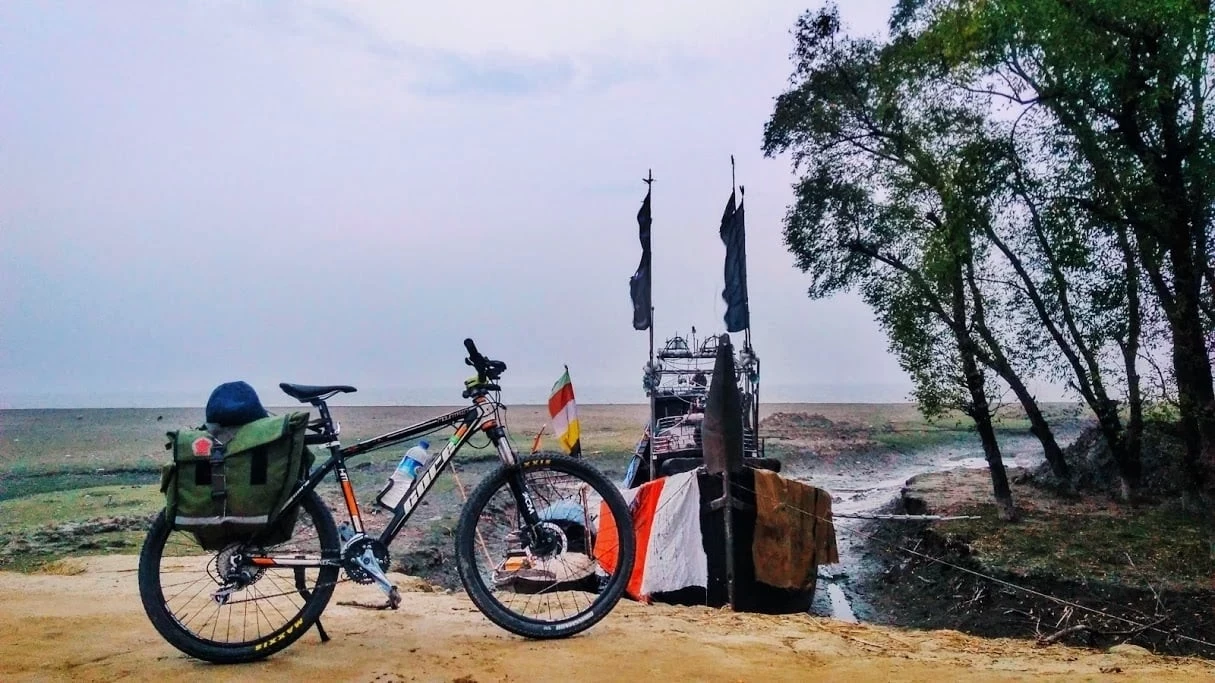
In the afternoon, I found myself at the banks of the Andharmanik river, where I decided to take a refreshing bath. Since I wasn't planning on staying at a hotel that night, I continued my journey. Arriving in Kuakata, I deliberately left the touristy area and headed east along the beach at a brisk pace. When I felt that I had put enough distance behind me, I settled down on the keel of a boat, positioning my tent between two fishing trawlers. Gazing upwards, I beheld the expanse of the sky.
The boat I found myself on was owned by two uncles, who happened to be brothers. They noticed my presence and struck up a conversation with me. Once they left, I unpacked my food supplies, changed into different clothes, inserted earphones into both my ears, and embarked on a leisurely walk along the beach. The entire stretch of coastline along the Bay of Bengal was mine to explore. In this solitude, I relished the sensation of being the sole proprietor of an entire beach, and with a solitary smile, I reveled in the moment.

The following day was a leisurely affair spent entirely on the beach, indulging in whatever activities I felt like. As the afternoon sun began to wane, I made my way to my uncle's house in Chapali Bazar. My uncle is a wonderful person, and upon arrival, I was greeted with warmth. His ten-year-old son, Maruf, spotted me and enthusiastically rushed over for a hug. Chapali village, located in Sagarpar, possessed a tranquil charm that provided respite from the urban hustle and bustle. It was the kind of place one might envision when yearning for a peaceful escape from the densely populated city.
On a fall afternoon, I adorned a cap or a pair of sunglasses and unbuttoned my sports shirt, strolling leisurely amidst the soothing surroundings of cowherd grass and red crab-dotted islands. I embarked on this stroll accompanied by two young boys—Maruf and his friend—who proved to be perfect companions for a meandering walk. As we ambled along, the boys engaged in animated chatter, and all I needed to do was nod and murmur in agreement, while gazing at the sun setting against the backdrop of the salty breeze. Together, we observed the fishing boats returning with their catch of open hilsa fish, and it was a delightful experience to partake in this scene of bustling activity while reclining in a relaxed posture amidst the late afternoon air.
After spending two fulfilling days in Chapali village and bidding farewell to my uncle and his family, I embarked on a journey to follow an entirely unfamiliar, uncharted path. My intention was to return to the mainland and travel to Chittagong in order to set sail from the enchanting island of Rangabali. The 13th day of my journey from home dawned with an overwhelming sense of excitement as I found myself in the captivating Maudubi of Rangabali upazila. With a leap of anticipation, I disembarked from the boat and embarked on a cycling expedition along a path that seemed to exude a magical allure. This marked the beginning of a new chapter in my journey.
The five days of island hopping hold a special place in my memory. During the first three days, with my phone battery at 39% and my Airtel SIM displaying 'no service', my life was devoid of any rush or disturbance. I conversed with myself and with the people I encountered along the way, knowing that these interactions were destined to be unique and once-in-a-lifetime. The days unfolded in a serene rhythm, the salty air embracing me as I indulged in what I loved most—cycling through fields, along paths, and losing myself in the sensation of floating in the river's embrace.
Life had taken on a gentle slowness, even though time itself seemed to be slipping by swiftly. On the 14th day of my journey, I reached Char Kukri—an eventful milestone. The trawler from Darbhanga in Char Montaj was scheduled to depart at 10 am, piloted by Shahid Bhai. However, when I arrived, it was already 11 o'clock. After obtaining his phone number and using someone else's phone to contact him, I waited patiently under the babra tree at Kheyaghat for two and a half hours. Eventually, he sailed his trawler all the way from Char Kukri to Montage, Kashem Mollar's sluice, just to pick me up. His gesture touched me deeply.
In each island I visited, my goal was to circumnavigate the entire landmass along the embankment. During my time in Kukri, I encountered a challenge—an eastward canal had been dug across the fence, rendering it impassable. However, I resolved to walk alongside the canal for approximately three kilometers through cultivated land. By the time I reached Kukri Bazar, evening was approaching. I quickly purchased a few packets of biscuits and set out to find a suitable camping spot. It was around this time that I became aware of the reality—I couldn't spend as freely as before; my resources were becoming scarce.
Walking along the embankment, I selected a spot for camping. A vast freshwater pond lay before me, and alongside it flowed the Hatuzal canal. On the other side of the canal were Keora and Golpata mangrove forests, and as I spotted an abandoned fishing boat anchored in the canal, I decided to make it my camping site. After setting up my camp, two children approached me and offered their assistance. Their simplicity was endearing, although it also made me feel slightly nervous in their presence. Their mother joined them for a brief interaction, during which I inquired about the boat's owner and explained my intention to camp there. She assured me that it would be no problem, and then she and her sons left to light an evening lamp in their house.
As I settled into my chosen camping spot, Emon Bhai arrived from downstream of the canal. Their fishing trawler was anchored nearby. Emon Bhai and his team had come from Satkhira by sea to catch fish, but their trawler's propeller was broken, and they found themselves stranded with little hope of repair. Emon Bhai extended an invitation for me to join them on their trawler, explaining that it would be less unsettling than staying alone in my tent. After some hesitation, I accepted his offer.
Emon Bhai's companions quickly gathered to hear my story, interrupting their work to do so. I climbed to the roof of the trawler after a refreshing swim in the freshwater pond and found them waiting with a plate of food for me. Under the open sky, atop the trawler's roof, I relished a meal of rice paired with freshly caught sea fish, marveling at my unexpected appetite. During the meal, I listened to tales of their nomadic lifestyle, gaining insight into their unique experiences.
Around two hours later, as I spread my tent on the trawler's roof and settled in to read by torchlight, my stomach remained contentedly full. The mysterious intricacies of human life's design often manifest in strange ways, shaping our experiences unexpectedly.
During the night, the eerie call of a jackal echoed from the nearby mangroves, and I pondered what it would be like to spend the night alone in my tent. The morning brought a somewhat unceremonious farewell from the Emon brothers. Yet, if I ever found myself in their situation, hopelessly stranded, I knew I could rely on their hospitality—I had been provided the phone numbers of four people in case I needed assistance.
That day, as the morning launch from Kukri arrived at Kachpia Ghat and I continued my journey towards Betua Launch Ghat, my bicycle's wheel punctured three times along the way. Each time, passersby graciously offered their help. Despite having the necessary tools myself, they insisted on assisting, explaining, "City people, let us handle this. Watch how we fix the puncture!"


As I settled into my chosen camping spot, Emon Bhai arrived from downstream of the canal. Their fishing trawler was anchored nearby. Emon Bhai and his team had come from Satkhira by sea to catch fish, That night I stayed in Manpura, and the following day I explored Hatia and Nijhumdwip. The subsequent day was dedicated to Afazia Bazaar, as I had missed Svandip's boat due to its ominous turnaround after lifting anchor from Banglabazar channel. I arrived at Afazia market seeking alternatives, making arrangements at a tea shop for Sandip's trawler and a Chittagong ship the next day.
After a night's rest at a budget inn, I woke up in the afternoon and strolled along the shores of the Bay of Bengal. In the enchanting evening light, I spotted MV Monirul Haque at anchor and indulged in my imagination. I envisioned myself as a pearl diver, sailing to Polynesia for several years. With newfound determination, I resolved to board the ship and head to Chittagong that very morning.
As the morning dawned, I embarked on MV Monirul Haque, a ship that took nine hours to reach Chittagong from Hatia. For the first two hours, my excitement kept me restless as I soaked in the surroundings. Later, I settled by the captain's cabin, gazing out to sea and engrossing myself in one of my favorite novels, "The Iron Mistress." It was a unique blend of experiences, and Captain Ankel noticed my engagement, engaging me in conversation about the lives of sailors. I gained valuable insights from our interactions.
Upon arriving in Chittagong, I found myself somewhat confrontational with the in-charge of Bandar Thana. My impatience flared when I went to inquire about a hotel, considering his seemingly lax attitude towards my inquiries. I don't know how, in that moment, my frustration boiled over at the sight of his nonchalance. However, the following morning, as I departed Hotez Raj, I revisited him to apologize. My genuine remorse and sincerity managed to break the ice, and we shared a laugh. As I walked towards the Shah Amanat Bridge, I checked the meter reading and felt a surge of exhilaration. The sudden uplift in my mood was palpable. Witnessing the vibrancy of a real city after a long while was refreshing, and the day shone exceptionally bright. It felt as if Chittagong itself radiated with luminosity, or perhaps each day there was naturally so radiant.
As I reached Anwara, had breakfast, and continued walking, my anticipation for a bridge grew stronger. The Sangu River was nearing its beloved Bay of Bengal, and there, in such a picturesque location, stood that bridge! Moving from north to south, as I ascended the slope of the bridge, the incredibly smooth path gently curved to the right, revealing a charming market like a painting. Colorful fruit stalls adorned the market, and the air resonated with Chittagong's regional songs from one of the shops. With the breathtaking Sangu River on one side and the tree-lined smooth road on the other, the excitement surged within me each time. I have passed through that dream-like market three times, and I've never cared to know its name. All I crave is to return to that spot over and over again. Just that one turn and after crossing the small Tilatakkar path, I have to board a boat from Magnama Ghat, venturing into the dusty realm of Pekua Upazila. As the day ends, I'm greeted by a huge red sunset in the strangely captivating Belabhumi of Kutubdia. I remain undecided about where to set up camp. That day, my tent was hung on a trawler in Belabhumi, and the sky featured a prominent full moon. Chatting with locals at a tea shop in the southern part of Kutubdia, I learned about the boat stranded on the sand. Inquiring about camping there, the brother smiled and replied, "No!"
What a night it turned out to be! The rising tide was pushing the boat around. The memory of reading "The Iron Mistress" by candlelight will forever be etched in my mind from that night. Candles became a necessity because I had lost my torch on Hatia Island. I had entered Maheshkhali Road from Kutubdia, and the experience filled me with fascination that persists even today. After crossing Tilatakkar in Maheshkhali and leaving Cox's Bazar town behind, I raced southward in excitement to witness Marine Drive. Even after leaving Marine Drive, I didn't divert my gaze left or right due to the crowd around me. I continued running southward because, at best, I desired to once again take in the grand expanse of the Bay of Bengal. The evening unfolded as I reached Sonarpara, beyond Himachari. It felt as though I had arrived at my destination. The memory of crossing Maheshkhali's boat, entering Cox's Bazar, and reaching Sonarpara stayed vivid. I hadn't even taken a sip of water since entering Cox's Bazar until that moment. I approached a roadside shop and declared, "I need food in three seconds, what's available?" I indulged in a satisfying meal without holding back.


Then, as I looked around, I set out to find an elderly man. I was in search of someone around my grandfather's age to have a conversation with. Eventually, I located such a gentleman sitting on a chair outside a shop, leisurely chewing his betel nut. How did all the restlessness of my mind dissipate in his presence? I explained my need for a camping spot, and he kindly designated an area for me. While the entire village was welcoming, he suggested I stay near Aziz Bhai's cousin. It was a location where I could easily access the sea. Before settling down, he advised me to visit Sonarpara, about two kilometers to the north. I followed his suggestion, went to the Sonarpara market, and enjoyed a satisfying meal of rice. The market impressed me; it turned out to be the largest betel leaf market in Bangladesh, bustling with truck after truck.
Then, I met Aziz Bhai. He works at a nearby hatchery and has a little spot by the sea where he guards the dredger pipe extending from the sand bottom. I engaged in extensive conversations with Aziz Bhai, learning a great deal about the sea and its fish. At Biswajora Pathshala Mor, I considered myself a student of everyone. After three days, I managed to call my mother back home and have a conversation with her. Aziz Bhai was kind enough to offer me his bed to sleep in, while my tent was set up about 150 yards away. Amidst the night, I walked along the world's longest beach once again. The entire stretch of the Bay of Bengal felt like it was mine alone. And you know what? It was a full moon night. As I walked, wandered, and let my thoughts drift, my mind transcended its ordinary state. Though my life lacked sorrow, sitting on the sand with half-wet feet dangling, I found myself shedding tears.
And then came Teknaf.
"If the world were a dreamland, my heart's desire would be to journey straight south along the Teknaf Road. Crossing the Naf River while tracing the coastline of the boundless Burmese kingdom, I would cross the Bay of Bengal's boundary and reach the shores of the Andaman Sea. I would navigate the Straits of Malacca and venture into Indonesia—a land of dreams—where I'd hop between islands in the Java Sea for what might seem like ages. Once my skin turned a deep copper hue, I'd set my sights on the Solomon Sea. For years, I'd wander through the New Guinea forest, traverse the jungle, scale mountains, and embrace the sea. When the ocean beckoned anew, I'd sail across the Solomon Sea, journeying south until I'd finally reach the shores of the Tasman Sea. Yet, I wouldn't proceed to Australia; instead, I'd venture further south, guided by my enduring fascination with befriending golden Polynesians. I'd drift across the Pacific on a modest raft, a lover of boredom, surviving on coconuts. And in moments of life's challenge, I'd turn to pearl hunting, retrieving gems from the depths of the Pacific. Never would I yearn to return, but instead, I'd construct a house adorned with the Pacific's radiant smiles in some unassuming island kingdom."

