


November '22
Tan's Stubborn Going...
Those days and the emotions they carried are etched deeply within my memory. Every morning I would awaken, feeling like a grand fool. I pondered, what folly it was to abandon my homeland in pursuit of celestial happiness, to wander the world's fields like a nomad. How negligent of me to disregard the greatest source of joy that lay right before me! My thoughts would often drift back to the imagery of Altentsetseg Firminbaishin, the elderly man puffing on his cigar, the enchanting lakeside, the gracefulness of Margarita… My mind would remain blank, and for a moment, I'd berate myself for my foolishness.
Then, out of the blue, a semi-dark room would materialize before my eyes, a square window devoid of grilles. In that room, with wooden walls, I sat upon a rickety chair, one arm resting on a weathered table, a scent of gunpowder lingering in the air. In my other hand, I gripped a cold Coca-Cola glass, its chill sending shivers down my spine. The sweet melody of heavy rain echoed persistently in my ears, while the mountain wind whispered an intoxicating rhythm, enticing deep breaths. Beyond the small window, the world unveiled itself in pitch blackness, punctuated by rare rolls of thunder. As far as the eye could fathom, there were only streams of dirty gray rain cascading upon the dark green tapestry of the mountains. From the unassuming radio atop the silent counter of the diminutive café, a piercing, soothing sound of Spanish folk music resonated… This café was situated in a remote town nestled at the foot of a distant mountain cliff in South America. I had never set foot there, never even heard of its existence, and yet I knew, with certainty, that such a café could be found in a town south of the Cordiera Blanca, awaiting my arrival. It was my destiny, my ultimate destiny, to sit there on one of the tempestuous evenings that grace the earth and savor a Coca-Cola.
Just as a droplet descends upon smoldering coals, igniting crimson embers, this image would pacify me, anchor me amidst the wild torrents of my restless mind. And yet, Margarita Alvarez presided over the spectrum of my life's joys, in her absence. Like an inert object, I continued to move forward, each second, each minute, each hour, with a heart shattered into fragments. How often did I contemplate returning? I've lost track of the number of times I ventured a little distance, only to retraverse my own path.
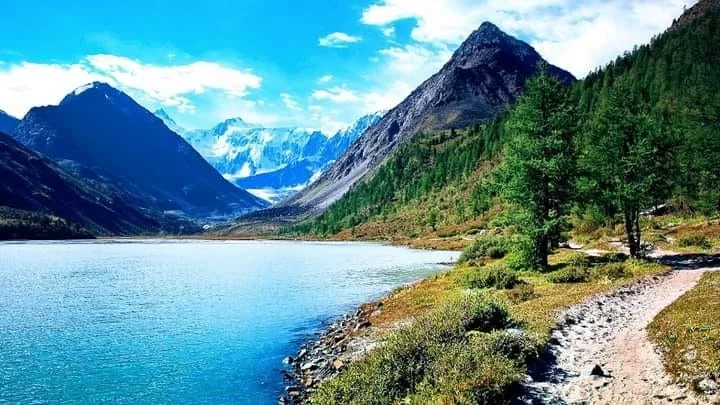
In this fashion, I pedaled for about ten days until I crossed the northern highway and reached the base of the relatively temperate Tarvagatai Mountains in central Mongolia. Scaling the mountain range, which peaked at approximately three and a half thousand meters, I emerged in an entirely different world! The verdant surroundings had undergone an enchanting transformation into shades of gray. However, the sky retained its deeply azure hue, an oddly beautiful phenomenon. Western Mongolia scarcely boasted any roads, yet its inhabitants, staunch adherents of traditional nomadic lifestyles, preferred the charm of the open landscape to urban and modern existence. Enclosed by towering mountains, they fashioned a spacious gar in the heart of a picturesque valley, amidst a backdrop of arid, crimson desert. Their abode encompassed their kitchen, bedroom, and living room in a single space. Among their customs, there was no protocol for knocking on doors, no concern for cost and benefit—every calculation centered around the pursuit of joy. Two or three days later, I found myself before one such family. They treated me to an abundant feast that day. None could fathom that I'd depart the following day, yet most could not accept my departure, save for Mrs. Delby. The mother of ten children, she seldom left my side, as I was versed in the Mongolian language and would regale her with stories. Their expansive household boasted over two hundred sheep, a hundred horses and yaks, and three hundred goats. Five of the seven sons were married, leaving only the youngest daughter, and the others had formed their own families. Festivity permeated the valley throughout the day—some children raced behind horses, while others leaped alongside frolicsome goats. A few children might have clung to the ropes of yaks, their laughter carried by the brisk wind. There was no hint of electricity here; candlelight illuminated the evening gatherings, where old Delbi's grandchildren regaled her with tales. Following the meal, conversations flowed over airag, and eventually, everyone retired to sleep. Inhabiting four vehicles, this extended family of around twenty individuals lived in harmony, facing no difficulties whatsoever. I slept in the oldest and grandest gar, a structure built by both Delbi and her late husband during their initial days of marriage. I spent three days in their midst, departing before lethargy could grip my body once more. Before my exit, Mrs. Delby generously packed my bag with non-perishable provisions, patting my head as she bid farewell to the day on which my journey commenced, venturing directly westward. Southward offered no hospitable terrain for humans. The Altai Mountains lay ahead, and one of Mrs. Delby's sons, whose name escapes me now, cautioned me about the presence of wolves in the area. Offering him a dry expression of gratitude, I admitted to my fear of wolves. Batta, who happened to be three years my junior, was already a father of two.
Two days preceding my twenty-second birthday, or so I believed, I was ensnared by a fever that left me weakened. I made camp on the outskirts of Mount Sutai, the tallest peak in the Altai Mountains. These next two days marked my final respite. I focused solely on myself and the past, refraining from allowing my thoughts to stray toward the future. The valley was incredibly frigid, and even packs of wolves dared not venture this high. I transformed into a polar bear instantaneously! Situated at four thousand and two hundred meters above sea level, a thread of path extended straight ahead of me, seemingly reaching to kiss the sky. Far below, the vista stretched over the vast expanse of the Sonoranga Plain. I idled away my time, reading books and sipping tea. Though I longed to listen to music, such pleasures were out of reach. During the second day, I awoke in the middle of the night for no apparent reason. But it was rare for me to be startled. Rising, I attuned my ears to the sounds around me. Stepping out of the tent now would ensure a prolonged effort to warm up again. Nonetheless, I swung open the door on one side and peered outside. I lit a small bonfire that had long since gone out. Observing for a while, I settled back inside upon realizing nothing untoward. Then, as if a prelude to the unexpected, a faint, roaring sound reached my ears—an angry growl reminiscent of a person's finger rubbing against glass, tinged with the tone of protracted wailing. Although I had never heard such a sound before, I instantaneously comprehended its source. My mind summoned a vivid montage of knowledge about snow leopards. Among the most endangered large cats, they possessed the capacity to eliminate any domestic animal within their reach. Yet, their reputation as attackers of humans remained nonexistent. "Unprecedented." I was never one to subscribe to the conventional; hence, I felt a modicum of unease. Without dwelling long on whether to venture outside and confront the creature or stay put, I prepared myself, undeterred by the cold. Grasping a piece of paper, I stood poised. Numerous tasks demanded simultaneous attention. In the span of three seconds, I seized a matchstick and ignited the paper, emitting a deafening shout as I lunged forward to face whoever or whatever lay before me. While I saw nothing, I discerned the sound of retreating footsteps, indicating the creature's fear. After scanning the surroundings from a distance, I confirmed my assessment. Subsequently, as the chill finally awakened me, I realized how tensed I had been!
Countless stars dotted the sky, and the fervor of the moment precluded slumber. Even if I wished to retreat indoors and sleep, the prospect eluded me. In the initial hour of my twenty-second year, I erected a grand bonfire beneath the open heavens, intensifying the brilliance of the Milky Way. As I rummaged through my bag in search of a coffee packet gifted by my grandfather, I accidentally encountered a metallic object, similar to a small chocolate bar, striking my hand. Irritated, I shoved it aside, yet words resonated in my mind like a lightning bolt: "Take out the cup and hold it in front of your eyes as if you can't believe it. I have Margarita's harmonica!" Uncertain of how it had wound up in my pannier, I speculated that Margarita must have sensed my impending departure. In some twist of fate, the most valuable gift of my life was conferred upon me unbeknownst to me by that enigmatic girl! Reflecting on this, a tinge of sorrow pervaded my thoughts—how melancholic she must have felt due to my abrupt exit! How many nights had she wrestled with her feelings, and how had her grandfather consoled her? Thwarting the resurgent currents of desire, which sought to draw me back to that paradisiacal valley, I settled with the harmonica in my hand. I stared for what felt like an eternity! Margarita's sweet visage was mirrored in that metal casing! She smiled at me, a touch of reproach in her eyes. I lacked the skill to play the harmonica, and even if I could, I would abstain. Margarita Alvarez was the one who played it, her lips having touched each aperture. The melody she conjured remained absent when I attempted to replicate it. Gazing at this wooden artifact, I could spend hours recollecting every shared memory with the girl, each one summoned sequentially! When I gingerly enfolded the harmonica in a napkin and ensconced it within the pannier's safest recesses, the bottom of the coffee pot lay dry. Every drop of water had evaporated! With a grin, I brewed coffee anew! Extracting a novel by Alan Quatermain, I reclined on the ground, serenading the dancing flames with a rough rendition of "Fell for her..."
"That's not a scary eagle at all," the boy calmly remarked. "That's Larissa, my pet eagle."
"A pet eagle? Are you kidding me?" I exclaimed.
"You think so?" he challenged. Then, looking up and seeing the eagle, he whistled, "Larisa, come here!"
To my astonishment, that fearsome bird swooped down at lightning speed and perched on the shoulder of the boy named Chokhra. The Kazakh boy glanced at me with a proud smile.
"I'm Tan," I introduced myself, extending my hand. "It's nice to meet you, and thanks for saving my life..."
"I'm Amir Khan Omarov," he replied, smiling sweetly. "Where are you from?"
"Originally from Bangladesh. My family lives in South Asia. But I've been traveling all over the world."
"Say what!" Amir Khan's big round eyes widened even further.
"What are you doing here? I don't see any houses around!" I inquired.
"I've come from quite a distance. Went hunting with Larissa, but haven't caught a rabbit yet. Saw the smoke from below and ran to see who the group of wolves was after!"
"The eagle... I mean, you've come to the right place! Thanks, bro! Put that on, let's head up to your camp first."
"Sure," I replied, busily packing up the tent. However, Amir Khan hadn't left yet. "Aren't you worried about missing your hunt?"
"No! I've got all the time in the world. I'm loving your setup!"
"Haha, thanks!"
"You seem interesting too. I'm sure you have a lot of stories?"
"Stories? I do. Want to hear?"
"Come on, let's not waste time!"
"Give me three minutes."
"No problem!" Amir Khan started looking around curiously at my scattered belongings, yet he hadn't noticed my bike yet. I had stashed it up in a tree at some distance.
"Where's your horse?" he asked.
"I don't have a horse. But guess what's here? You're in for a surprise."
"Really?" Amir Khan's curiosity intensified.
"Yeah!"
"Wow!" He was taken aback.
I grinned and led him to the bicycle. Amir Khan's attention was diverted for a moment, but then he stared at the bike in awe. He had heard about this peculiar two-wheeled vehicle all his life.
"How did you come here from Bangladesh with this, Mr. Tan?"
"I didn't bring this, Amir. It brought me."
"You mean to say…!"
"Yes!"
"Wow!" He was flabbergasted.
I chuckled and motioned for him to step aside. My explanation alleviated his bewilderment. After about half an hour, we had scaled a sizable hill when something remarkable occurred—his horse began running alongside my bicycle, and Amir Khan was barraging me with questions at the pace of a tape recorder. I responded tirelessly. Much like others, he was impressed by my extensive journey and my intentions. Upon glimpsing a village named Sagan-Gol in the distance, I happily accepted his invitation to stay for a week. Mocking Nimraji briefly, I caught sight of their village shortly thereafter. Gar, his round and shapeless dwelling, was visible from afar. It felt as if I had transitioned to a different world even within Mongolia—the Kazakh-Mongols led lives distinctly separate from the Mongolians. Although their existence shared many traits with the nomadic Mongols, I detected a more contemporary sentiment. In this golden valley of the Altai Mountains, a mosque, a shop, and—unbelievably—a restaurant were present. Amir Khan revealed that everyone in the settlement couldn't go to sleep in the evenings without indulging in Gramsera dumplings and sherbet prepared by Mrs. Aisha.
Before long, evening descended upon us, and I accompanied Amir Khan. He was his family's only son—a beloved younger brother to three elder sisters. Their house, the closest to the canal, was theirs. We met Amir Khan's father before entering the village. Mr. Alikhan, like his son, possessed a humorous and affable demeanor. He was elated to see me, so much so that he abandoned his fishing to join us on the way to his house. The Omorovs' wooden residence was as colorful as the other houses in the village. While I left my bicycle in their barn, Mrs. Khan and her daughters were busy preparing dinner. Amir Khan, however, informed me that we'd be dining at Mrs. Aisha's place tonight. I don't know what might have transpired otherwise, but he literally dragged me around the village, almost running. I couldn't fathom the multitude of horses scattered throughout the village! As evening approached, everyone gathered their horses. Amir's sisters took care of his horses that day, rendering his assistance unnecessary. Afterward, we offered the Maghrib prayer together in the mosque situated at the village's center. I couldn't recall the last time I'd seen a mosque before that day. The otherworldly atmosphere within the mosque, accompanied by its evocative fragrance, remained etched in my memory.
Mrs. Aisha's kitchen was a delightful sight. As we entered, a courtyard-like open space illuminated by a small fireplace emerged from the surrounding darkness. Round tables were scattered around, and Amir and I chose one of them. When I sat in the light of the lamp, a sense of lightness overcame me—as if I were as weightless as a bird's feather. In the company of Amir, I felt content to simply listen. Two young women at a neighboring table were singing in an open and unintelligible manner, with more laughter than singing. They seemed to be lifelong best friends, radiating happiness. Their smiles were infectious, and I found myself smiling too. Placing both hands on the table and resting my head on them, I silently smiled to myself, basking in the moment. I laughed for a long time, and when the laughter finally subsided, my eyes were watery from the mirth.
Amir returned with our plates, grinning as he swayed to the rhythm and shouting praises in Kazakh to the girls. On the plate were horse meat dumplings, known as "manti" in Kazakh, beef kebabs, and "horshur." Horse meat was a popular choice among the Kazakhs. It was my first time trying horse meat, and despite my initial reservations, I found it surprisingly delicious. It was juicy like beef but possessed a hint of sweetness. The texture was thinner, and even when somewhat undercooked, it didn't require much effort to chew. Mrs. Aisha's cooking skills were exceptional. I could see a small hut nearby; that was the kitchen. The interior was warm, and an elderly woman with jet-black hair was tending to a coal stove. I couldn't determine whether her hair color was natural, given how dark it was. She was surrounded by eager helpers and devotees, some even assisting her.
"So, Amir, what's the secret? Why is Mrs. Aisha so popular?" I inquired.
"Actually," Amir said, his mouth full as he ate, "the food here is so interesting! And she knows many stories. She's familiar with every valley in northern Mongolia. Her father was a nomad, wandering everywhere."
"Wow. It sounds like someone much like me, rich in stories!"
"Mr. Tan..."
"Aw, come on! Please don't call me Mr. Feaster. Just Tan."
"Hey, what do you mean? You're not much older than me. I can't just call you by your name like that, Guru!"
"Back to being a teacher again!" I chuckled. "Alright then, Amirkhan Omarov. Okay, tell me, brother Tan. Do you know what that means? 'Brother Tan.' But calling you 'Brother Tan' makes it sound like I'm a pastor at church."
"Tan brother!" he said with a mischievous grin. "Where did you learn to speak so eloquently?"
"From everywhere, Amir. From the sky, the mountains, the wind-blown dust, the soil underfoot, raindrops, desert sands. I've learned from the moon's light, monsoon winds, ocean waves, towering mountains, swift rivers. Sometimes I've learned from the grandeur of friendship, the gaze of an elder, or the smile of a child! I'm a student of everything in the world."
"You're amazing, brother! If I had a brother like you, wouldn't that be great?"
"Ah," I smirked, "if you had a brother like me, he'd pile all the responsibilities onto you and tumble down himself, every time, including the last time."
"When you put it that way, I won't argue."
"Speaking of which, don't you want to go to school?" I brought up Amir's touchy subject.
"Don't even mention it!" he waved his hands as if to shoo away an unwanted presence. "You know what a terrible thing that is? If you go in the morning, you won't be back before noon. Every single day! My cousin from my hometown writes twice a year and goes to school in Murun. Ugly man! But do you like school, bro?"
"Whether I like it or not doesn't matter. But let me tell you, I've managed to escape from grown-up school—a.k.a. university."
"That's why I enjoy hanging out with you so much! Hoo ho! Wait, let's get another plate of kebabs..."
Before I could say anything, a Kazakh teenager hurried to Mrs. Aisha's kitchen and returned with another plate of horshur.
"Tan brother, if you're up early tomorrow, come with me. I'll show you how to hunt rabbits with an eagle. Will you come?"
"Absolutely. But... I don't have a horse..."
"Hey, I have ten horses of my own. You can take your pick. Just say you're in! Tomorrow is going to be a fantastic day!" Amir exclaimed.

